

Let’s be honest: one of the most common questions women in Kenya ask when discussing family planning is, “How do I calculate my safe days?”
Many young women and couples rely on the Calendar Method (commonly called “safe days”) to prevent unplanned pregnancies without using hormonal contraceptives like the coil, implants, or daily pills. But while natural family planning is a valid choice, relying on guesswork can easily lead to a surprise pregnancy.
1. What Exactly is the "Safe Period" and "Fertile Window"?
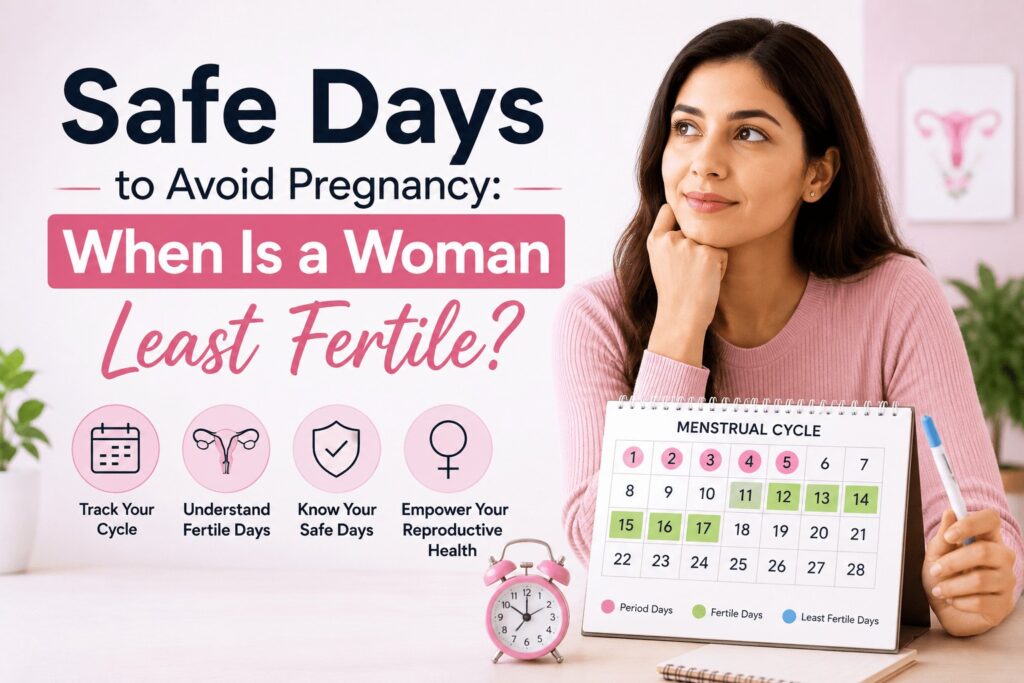
To understand when it is safe to have unprotected sex, we have to look at the biology of a woman’s menstrual cycle. In any given cycle, there are only a few days when you can actually get pregnant. This is called your Fertile Window.
- The Lifespan of an Egg: Once your ovary releases an egg (ovulation), that egg only lives for 12 to 24 hours. If it isn’t fertilized by a sperm in this window, it dissolves, and pregnancy cannot happen.
- The Lifespan of Sperm: Sperm can survive inside the female reproductive tract for up to 5 days.
- The Fertile Window: This means your “fertile window” actually starts 5 days before you ovulate and ends 1 day after you ovulate. Having unprotected sex during these 6 days carries a high pregnancy risk.
- The Safe Period: Your “safe days” are the times in your cycle outside of this 6-day fertile window.
2. How to Calculate Your Safe Days (Step-by-Step)
To calculate your safe days, you must track your menstrual cycle for at least 6 months to find your shortest and longest cycles. Here is the standard clinical method (Standard Days Method) for regular cycles between 26 and 32 days:
Start of Menstruation
Day 1 is the very first day you see bright red blood. Mark this day on a calendar or tracking app.
The Fertile Window
If your cycle is regular (26 to 32 days), Days 8 through 19 are considered your fertile window. Avoid unprotected sex during these 12 days.
First Safe Phase
The days during your period and immediately after (Days 1 to 7) are generally lower risk, though caution is needed if your cycle is very short.
Most Reliable Safe Phase
Once you pass Day 19, the egg has dissolved. Day 20 until your next period starts is the safest window for unprotected sex.
3. The 3 Biggest Reasons the "Safe Days" Method Fails
The real-world failure rate of the calendar method is about 12% to 24% with typical use due to several factors:
- Cycle Irregularity: Stress, changes in diet, exams, travel, or mild infections can shift ovulation timing unexpectedly.
- Spotting vs. Real Periods: Mistaking light ovulation spotting for a period throws off calendar math completely.
- Over-reliance on Default Tracking Apps: Apps assuming every woman has a perfect 28-day cycle often predict incorrect safe days.
4. How to Double-Check Your Ovulation Safely
Combine calendar calculations with biological fertility markers for better tracking:
| Biological Marker | Near Ovulation (Unsafe) | During Safe Days |
|---|---|---|
| Cervical Mucus | Wet, slippery, stretchy (like raw egg whites) | Dry, sticky, thick, or absent |
| Basal Body Temp | Spikes up by 0.2 to 0.5 degrees post-ovulation | Stays at baseline, flat temperature |
| Cervix Position | Soft, high, and slightly open | Firm (like tip of nose), low, and closed |
What to Do If Your Calculations Fail
If you have unprotected sex during your fertile window unexpectedly, emergency contraception (ECPs) works best when taken within 72 hours. If your period is late, reach out for supportive, confidential guidance.


